

7 Words with Multiple Spellings (and How to Choose the Best One)
The English language can be a frustrating beast sometimes, most often when you’re faced with words with multiple spellings but the same meaning. The choice can be agonizing. Is it gray or grey? Alright or all right? Gah! A lot of choosing correctly comes down to what’s most common in published books for your particular English dialect, and what the dictionary prefers. Here are 7 words with multiple spellings and how to choose the best one as you’re self-editing.
Towards vs. Toward*
Let’s begin with one of the words that seems to either cause indie authors the most stress or sparks the most passionate defense: Is it toward (no s) or towards (with an s)?
I say “passionate defense” because quite a few of you out there seem to have some very strong feelings about using towards, even though (surprisingly) it’s considered less common in the United States.
Toward and towards are two forms of the same word. They have been used interchangeably since their inception in the 9th century. Today, toward is more common in the U.S. and Canada, while towards tends to be preferred elsewhere. — Merriam-Webster’s Unabridged Dictionary (Source)
American publishers mostly recommend using toward in their house style guides, and indeed, that’s the spelling I notice in the majority of the traditionally published books that I read and edit.
So it makes me wonder: Where does the “I will die on this hill” embrace of towards originate?
I find that quite a few American indie writers have grown up reading a healthy dose of books by British authors, where the standard usage is towards—notably, for the fantasy writers, of course, Tolkien’s works. So my conclusion is that towards has worked its way into the American lexicon tapped by fantasy authors, probably subconsciously, and reading Tolkien forms many fond core memories for most of us. Using toward then feels almost sacrilegious.
So how do you choose? If you feel that righteous rage rising when you write toward—by all means, keep that ending s on there.
If you don’t have that much of a preference, or you want your book’s spelling and style to hew as closely to typical American publishing standards as possible? Choose toward.
Just apply the Golden Self-Editing Rule: keep it consistent.
*This choice also applies to other -ward words: backward, forward, upward, downward, onward, etc. If you choose toward make it -ward for all the rest, and vice versa.
Alright vs. All Right
This choice is a bit more cut-and-dried, at least per MW:
Although the spelling alright dates to the mid-19th century, some still insist alright is all wrong. The objection seems at its core to be based on little more than the form’s newness: altogether and already, which formerly were frequently spelled as two words, settled into their current spellings in the 18th century, making alright a relative upstart. All right continues to be much more common than alright in published writing, but alright is increasingly found there too. Some like to distinguish between the forms, reserving all right for meanings such as “entirely correct” and “only those on the right,” and alright for the other meanings, but that distinction is not widely employed.—Merriam-Webster’s Unabridged Dictionary (Source)
Again, American publishers tend to prefer all right, two words. In my work for the imprint I freelance for the most, it’s a pretty firm style choice, with rare exceptions.
So with my usual “if you have a strong preference, use that” caveat, I recommend choosing all right for your work, given its commonality.
Gray vs. Grey
Like with toward vs. towards earlier, and a others I’ll talk about in a bit, this spelling seems to come down to a question of US vs. British/Canadian English:
Gray and grey are both accepted spellings. Gray is more frequent in US English, while grey is preferred in Canada, the UK, and elsewhere.
However, I want to point out an important bit of detail in the entry for gray in Merriam-Webster’s that you can apply for any other choice between same-word spellings you need to make.
Right under the actual word and its part of speech on the entry page for gray, you might notice this:
variants or less commonly grey
In the style guidelines used by the Big 5 traditional publisher of fantasy, horror, and sci-fi that I work for, they generally recommend avoiding variants given in Merriam-Webster’s with the or less commonly attribute, reasoning that the degree of lesser commonality might give American readers pause when that variant is used. If you’re writing for an American audience, you might decide that using the spelling they’re used to seeing in traditionally published books is the most accommodating choice.
But, as with every other this vs. that in this post, if you have strong feelings about grey, use it.
Pro tip: A quick way to remember which spelling of gray is American and which isn’t—look at the vowel. G-R-A-Y has an A, so it’s American. G-R-E-Y has an E, so it’s English.
Among vs. Amongst
God love amongst (and its close cousin, amidst*, to which this section also applies). It’s such a fancy-schmancy, high-tea-at-four word, so much so that choosing it over the plainer, more awkward-sounding among must be more correct, right?
Well . . . no, not necessarily.
Amongst is another of those or less commonly words I mentioned in the last section, which means Merriam-Webster’s believes its usage in modern American English to be pretty uncommon. Notably, unlike grey, the entry for among does not include a usage guideline for amongst explaining its British roots. So where does it come from, and why do fantasy authors use it so much?
Let’s turn to another tool you might find handy for making spelling decisions: the Google Books Ngram Viewer. It’s a nifty search engine you can plug two words into for a side-by-side comparison of each word’s frequency in books over time. Using Ngram for amongst vs. among, we get this:
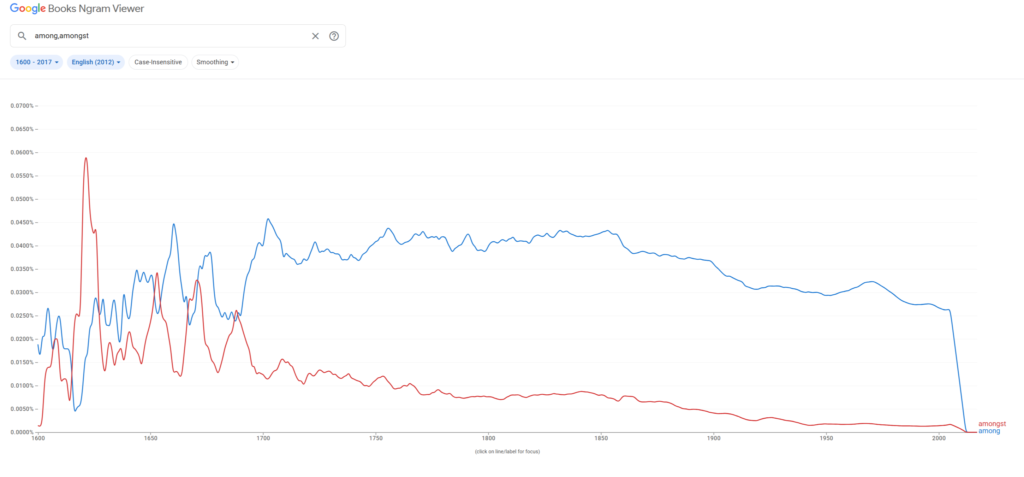
Cool. Looks like amongst had its heyday in the 17th century! Which makes it practically a fossil.
In fact, Mignon Fogerty, otherwise known as Grammar Girl and host of the podcast by that name, says this about the word:
Amongst is considered archaic and overly formal or even pretentious in American English. The only time I can think of when it would be appropriate for an American writer to use it would be in fiction set in a different era or world. Something like this:
- Is it truly safe to walk amongst the peasants, my lord?
- Dear listeners, I hope this trifling is amongst your favorites for the week. (Source)
Ouch, harsh.
However, she has a good point, and her first example illustrates why I think amongst shows up so much in fantasy especially. It’s formal, pretentious, archaic, belonging to another time—sounds about right for kings and queens and sword-wielding knights of the realm, right?
So, which should you choose, among or amongst? I think for this pairing, it might come down to voice. What kind of tone are you going for? What language choices do your characters make? Are they meant to sound stuffy and uppity? Maybe amongst fits the best. Are you trying to invoke imagery of royalty, political intrigue, formal decrees, high-stakes hierarchical societies? Amongst, FTW.
If not, among might be more your book’s jam.
For this choice, there’s probably not one “right” answer or easy guideline to follow. You might have to let your book’s setting, time period, worldbuilding, and character voice guide you here. But at least you can make an informed decision.
*As mentioned, this same logic probably applies to amid vs. amidst as well, although Merriam-Webster’s considers amidst more common. See this entry.
Leaped vs. Leapt
Now for some great news! If you’ve ever written the word “leaped” and agonized over whether it should actually be “leapt” (or vice versa), worry no more. Either one is A-okay.
Merriam-Webster’s lists “leaped” first as the simple past tense of “leap,” so it tacitly endorses “leaped” as the most common or most . . . accepted, perhaps?
However, the entry states that the simple past can be “leaped or leapt”—and that or makes all the difference.
In my work for Macmillan publishers and its imprints, specifically St. Martin’s and Tor, their house style guide recommends that any word with multiple spellings for tenses separated by or are equally acceptable.
So if an author prefers “leapt” and MW says it can be “leaped or leapt”—then “leapt” it is, as long as that form is used consistently across the work.
In my work with indie authors, I usually apply this same logic, just to make the editing decision a bit easier. If an author shows a consistent preference, and the dictionary says either one is fine, I go with the author’s choice.
If that’s “leapt,” then Bob’s your uncle. If that’s “leaped,” that’s all good, too.
Burnt vs. Burned
So. After “leaped” and “leapt,” you might be thinking this pairing should be similar, right?
Non. (<–That’s French for “hell no.”)
These words are sneaky, sneaky. Because (simplified) one is an adjective form and one is a verb form. Ooh la la. The choice here actually depends on what function the word is serving in the sentence.
And bear with me—because English makes absolutely no sense sometimes, we’re going to venture into the grammar weeds.
In theory, and in the dictionary, the words “burnt” and “burned” can be used interchangeably as either a verb or an adjective.
- My toast was burnt. I don’t like burnt toast. (adjective)
- They burned the town down over this travesty. (verb)
- The burned toaster got what it deserved. (adjective)
- But all of my bread burnt up, too. (verb)
In practice, it’s not quite that simple, and that’s mostly because of the good old American vs. British English usage that we explored with “among/amongst.”
Burnt as a past-tense verb is more commonly British usage. Burned is more prevalent in America.
The adjective burnt is actually the past participle form of the verb “burn” being used to describe something and may actually sound more correct in any English dialect: think burnt sugar or burnt toast.
‘Burned’ is the usual past tense of ‘burn’, but ‘burnt’ is common in many contexts when the past participle is used as an adjective (“burnt toast”). Both are acceptable forms.
So, in the same way we’d think about character voice and tone when deciding to use among vs. amongst, we can consider what would be more appropriate for our story when choosing between burned/burnt. Either one is correct.
OK vs. Okay (vs. ok)
At this point, you probably know the drill: What does Merriam-Webster’s say?
With OK/okay/ok, MW lists them all as variants, with “OK” and “okay” having equal weight. The totally lowercase “ok,” however, is considered less common.
variants or okay or less commonly ok (Source)
I see a huge variety of spellings and capitalizations of this simple, short word across manuscripts, even within the same manuscript. This is a word that I usually clear with an author if there’s no preference established, and if the author doesn’t care much what gets used, I tend to apply “okay” as being (in my opinion) slightly more readable.
So: OK or okay? Either one is fine. But probably avoid ok if you can help it.
Conclusion: Be Consistent
When you’re caught in the agonizing “this or that” trap of choosing between words with multiple spellings and which is most appropriate for your book, follow this decision chain: Is the word in Merriam-Webster’s? If so, which version is listed first? If I don’t like that version, does my preference get equal weight from the or between them? If not, am I going to cause readers grief by using my preference if that spelling isn’t common in my readers’ primary English dialect? And, frankly, do I care? Is a little reader pain worth what the word brings to my story’s voice, tone, formality? Hopefully, that gets you to a decision with much less trauma.
Regardless, though, the main point is this: When you’ve made a choice, stick with it. Be consistent with your spelling throughout the entire manuscript. Record your choice on your problem word list so you can remember it later. And, most important, communicate your preference to your editor, especially if it’s not a typical or common usage of the word.